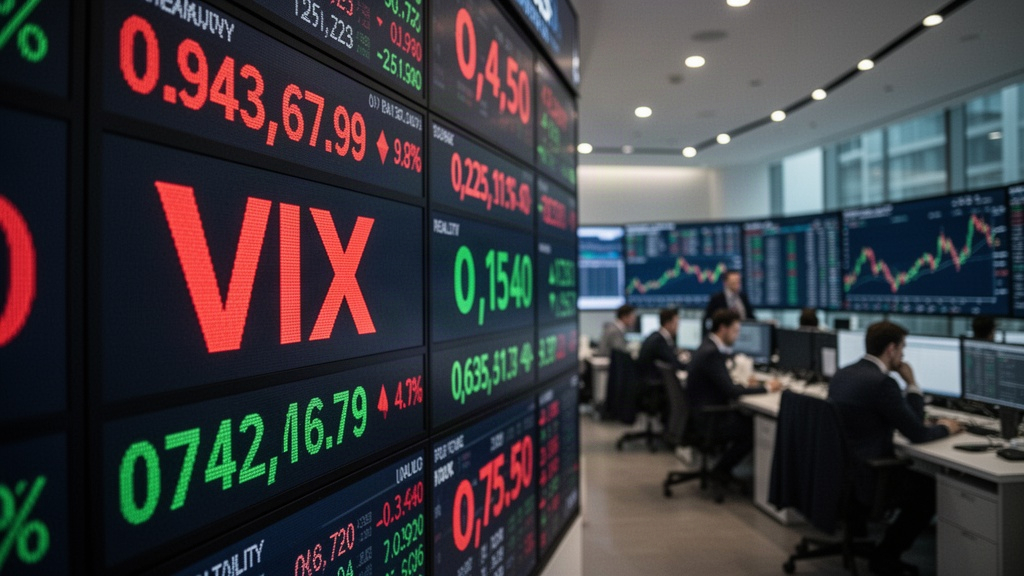
VIX stock has become one of the most watched categories of financial instruments among institutional and retail investors alike. As markets navigate persistent inflation pressures, shifting monetary policy, and ongoing geopolitical uncertainty, understanding how to position around volatility has never been more relevant. The Volatility Index, maintained by CBOE Global Markets, measures the market's expectation of near-term volatility based on S&P 500 options — and the instruments tied to it offer both hedging opportunities and speculative plays. Whether you are new to volatility trading or refining an existing strategy, what follows gives you a clear-eyed view of where things stand and what to watch heading into 2026.
What the VIX Index Actually Measures
The VIX Index, formally known as the CBOE Volatility Index, was developed by CBOE Global Markets in collaboration with S&P Dow Jones Indices. It calculates implied volatility from a broad range of S&P 500 index options, both calls and puts, across multiple expiration dates. The result is a single number that reflects how much the market expects the S&P 500 to move over the next 30 days, annualized.
A VIX reading of 15 signals a relatively calm market. A reading above 30 typically reflects fear, panic selling, or a significant risk event. The index does not predict direction — it measures expected magnitude. That distinction matters enormously for anyone building a position around volatility instruments.
CBOE publishes the VIX in real time during trading hours, and the data is freely accessible on their official platform at cboe.com. The index itself cannot be traded directly. What investors actually buy or sell are VIX futures, VIX options, or exchange-traded products like ETFs and ETNs that track VIX futures indices. Each of these instruments behaves differently from the spot VIX, a point that trips up many first-time volatility traders.
Understanding this gap between the spot index and tradeable products is the starting point for any serious engagement with VIX-linked instruments. The futures curve — whether it is in contango or backwardation — has a direct impact on the returns of VIX ETFs, often eroding value in calm markets even when the underlying index stays flat.
How VIX Stock Has Performed in Recent Years
The term "VIX stock" broadly refers to the family of exchange-traded products linked to VIX futures, including tickers like UVXY, SVXY, and VXX. These instruments have seen significant trading volume growth over the past five years, with some estimates pointing to an annualized growth rate of around 5% in assets tied to VIX-related products.
That growth has not been linear. The COVID-19 shock in 2020 sent the VIX above 80 — a historic spike that briefly made long-volatility positions extraordinarily profitable. The subsequent years saw the index normalize, oscillating between 15 and 25 for extended periods. Inverse volatility products like SVXY recovered strongly in calm stretches, while leveraged long products like UVXY experienced the expected decay that comes with holding futures in contango.
BlackRock and Vanguard, two of the largest asset managers globally, have incorporated volatility analysis into their risk management frameworks, though neither offers a pure VIX ETF under their own brand. The space is dominated by ProShares and Barclays-linked products, which continue to attract both institutional hedgers and short-term traders.
One pattern worth noting: VIX-linked products tend to underperform during extended low-volatility regimes. Investors who held long VIX positions through 2017, one of the calmest years on record, saw substantial losses. The instrument rewards timing and risk awareness, not passive holding.
What Is Driving VIX Stock in the Current Environment
Several forces are shaping the volatility landscape right now, and each carries a different weight depending on your investment horizon. Investors tracking VIX stock should monitor these factors actively:
- Monetary policy shifts: Central bank decisions on interest rates directly affect equity market uncertainty. Any unexpected pivot — whether a surprise rate cut or a hawkish hold — can send the VIX spiking within hours.
- Geopolitical tensions: Ongoing conflicts and trade disputes between major economies create episodic volatility spikes that are difficult to predict but highly profitable for those already positioned long.
- Corporate earnings seasons: Quarterly earnings from S&P 500 heavyweights like Apple, Microsoft, and Nvidia generate localized volatility that feeds into the broader index reading.
- Inflation data releases: Monthly CPI and PCE reports remain market-moving events. A surprise to the upside or downside can shift volatility expectations sharply within a single session.
The VIX index average is projected to hover around 20 through 2026, according to current market expectations. That level sits in a moderate zone — elevated enough to make hedging worthwhile, but not so high as to signal imminent crisis. For investors in VIX-linked products, a mean of 20 suggests a market that is watchful rather than panicked.
Volatility forecasts remain inherently uncertain. Unexpected events — a bank failure, a geopolitical escalation, a sudden policy reversal — can override any projection within days. The 2023 regional banking stress in the United States demonstrated how quickly a contained issue can ripple into broader market fear.
Practical Approaches to Investing in Volatility Instruments
Positioning in VIX-linked products requires a clear strategy before any trade is placed. The most common approaches fall into two camps: hedging and speculative trading.
Hedgers typically hold a small allocation to long VIX products — often 3% to 5% of a portfolio — as insurance against sharp equity drawdowns. When the S&P 500 drops 10% or more, long VIX positions frequently gain 50% to 100%, partially offsetting losses elsewhere. This approach works best when the hedge is rebalanced regularly, since the cost of carry in contango markets erodes value over time.
Speculative traders take a different angle. Many professionals short VIX products during periods of elevated volatility, betting on mean reversion. SVXY, the ProShares Short VIX Short-Term Futures ETF, gained over 100% in 2019 as volatility collapsed after the 2018 spike. That trade carries significant tail risk — a volatility surge can produce losses that exceed initial investment in leveraged inverse products.
A third approach gaining traction among sophisticated investors is options on VIX futures. These allow for defined-risk positions that benefit from volatility spikes without the daily decay inherent in ETF structures. CBOE offers a comprehensive range of VIX options with various expiration dates, giving traders precise control over their exposure window.
Regardless of approach, position sizing is non-negotiable. VIX instruments are not designed for large, long-term allocations. Even experienced traders at major investment firms treat these as tactical tools rather than core holdings.
Making Sense of VIX in a Portfolio Context
The real value of monitoring the VIX index lies not in the trade itself but in what it reveals about broader market sentiment. A rising VIX often precedes equity weakness by days or weeks. A falling VIX in the aftermath of a shock signals that institutional investors are growing comfortable again — a potential entry point for risk assets.
Investors who integrate VIX readings into their portfolio management process gain an additional signal layer that price action alone cannot provide. When the VIX is below 15 and equity markets are near all-time highs, the cost of buying protection is low. That is precisely when most investors ignore it — and when it tends to be most valuable.
The relationship between VIX and asset allocation decisions is well-documented in academic finance. A 2022 paper published in the Journal of Financial Economics found that portfolios that systematically adjusted equity exposure based on VIX thresholds outperformed static allocations on a risk-adjusted basis over a 20-year period.
For anyone serious about managing a portfolio through uncertain conditions, the VIX is not a speculative sideshow. It is a real-time gauge of collective market anxiety — and knowing how to read it, and when to act on it, separates reactive investors from deliberate ones.