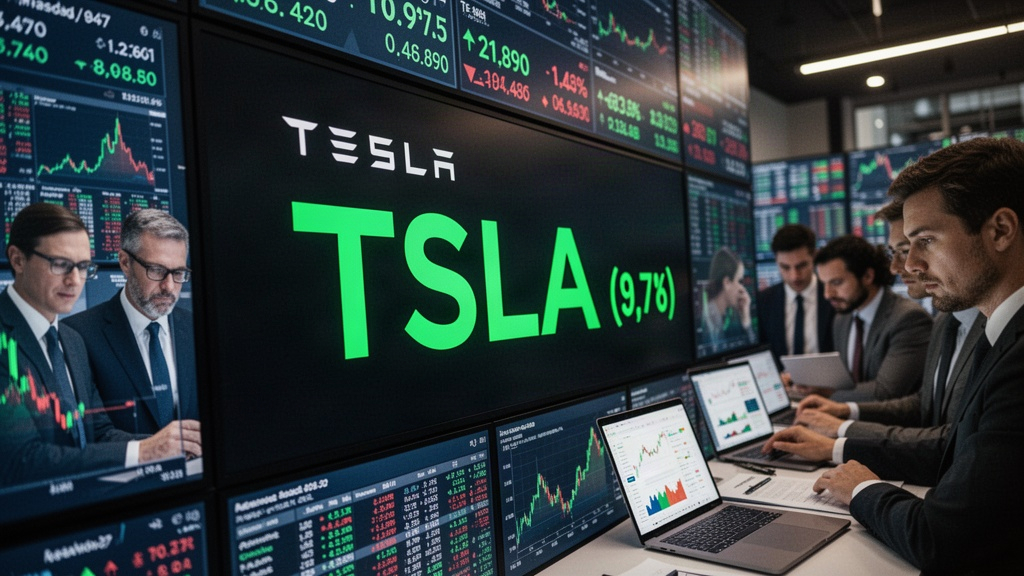
Nasdaq: TSLA has become one of the most closely watched tickers in global financial markets. Whether you are a seasoned portfolio manager or someone building wealth for the first time, Tesla's stock demands attention right now. With a market capitalization hovering around $1 trillion and a stock price near $950, TSLA sits at an intersection of technological ambition and real financial momentum. The company posted 30% revenue growth in 2025, expanded manufacturing capacity across two continents, and continues to attract both institutional and retail investors at scale. The five reasons outlined below are grounded in data, market structure, and strategic positioning — not speculation.
Understanding the Current Market Conditions Around TSLA
Electric vehicle adoption is no longer a niche story. Government mandates, corporate fleet electrification targets, and falling battery costs have created a structural tailwind that benefits Tesla, Inc. more than any other publicly traded EV company. In the United States, the Inflation Reduction Act continues to channel billions toward clean energy infrastructure, making EV purchases more affordable and indirectly supporting demand for Tesla's vehicles.
Interest rate movements matter here too. As the Federal Reserve signals a more accommodative stance heading into the second half of 2026, growth stocks with long-duration earnings profiles become more attractive. Tesla fits that profile precisely. Lower borrowing costs reduce the discount rate applied to future cash flows, which mechanically lifts the theoretical valuation of high-growth companies.
Equity markets have also shown renewed appetite for technology-adjacent industrials. Investors who rotated out of pure software plays are now seeking companies that combine hardware manufacturing, software monetization, and energy services under one roof. Tesla offers exactly that combination. Its energy storage division, led by the Megapack product line, generated record revenues in 2025 and now represents a meaningful percentage of total company income.
Global competition from Chinese manufacturers like BYD remains a genuine pressure point. Yet Tesla's brand premium, its Supercharger network, and its software-defined vehicle architecture give it a differentiation that pure cost competitors struggle to replicate. The market appears to have priced in competitive risks while still rewarding Tesla's execution track record.
Read also: Why is nasdaq: tsla a Top Choice for Investors in 2026
Tesla's Financial Performance and Revenue Growth
Numbers tell a clear story. Tesla's revenue grew 30% year-over-year in 2025, a rate that most legacy automakers can only observe from a distance. That growth did not come from a single product line or geography — it reflected broad-based strength across vehicle deliveries, energy generation, and services revenue including software subscriptions and insurance.
Gross margins, which had compressed in 2023 and 2024 due to aggressive price cuts, stabilized and began recovering in 2025. Manufacturing efficiency at the Texas Gigafactory and the Berlin facility improved significantly as production volumes scaled. Higher throughput spreads fixed costs over more units, and Tesla has consistently demonstrated its ability to extract cost reductions from its supply chain over time.
The company's balance sheet remains a competitive asset. Tesla holds substantial cash reserves with minimal long-term debt relative to its earnings capacity. That financial flexibility allows management to fund new product development, expand manufacturing, and pursue share buybacks without relying on external financing at unfavorable rates.
Free cash flow generation accelerated in 2025. For equity investors, free cash flow matters more than accounting profit because it represents actual capital available for reinvestment or return to shareholders. Tesla's free cash flow conversion rate improved as capital expenditure intensity moderated relative to revenue growth. Analysts at major investment banks, including those covering the technology and automotive sectors, revised their price targets upward following the Q3 and Q4 2025 earnings releases.
The Innovations Driving Long-Term Stock Value
Full Self-Driving technology represents the single largest optionality embedded in Tesla's valuation. If autonomous driving reaches commercial viability at scale, the revenue model transforms entirely — from selling vehicles to operating a robotaxi network. Tesla has accumulated more real-world driving data than any competitor, and its neural network-based approach continues to improve with each software update pushed to the existing fleet.
Read also: How to Spot the Best Opportunities in Palantir Stocks
The Optimus humanoid robot project moved from prototype to limited production in 2025. While revenue contribution remains modest today, the long-term addressable market for general-purpose robots in manufacturing and logistics is enormous. Tesla's ability to leverage its existing AI infrastructure, battery technology, and actuator expertise gives it a credible path that pure robotics startups cannot easily replicate.
Energy storage is a less glamorous but highly profitable growth vector. Megapack deployments surged in 2025 as utilities and grid operators scrambled to add storage capacity alongside renewable generation. Tesla's manufacturing scale and cost structure give it a durable competitive position in this market, and backlog visibility extends well into 2027.
Next-generation vehicle platforms, including the more affordable model targeting mass-market price points, are scheduled for production ramp in 2026. Lower average selling prices will compress per-unit margins initially, but volume growth and software attach rates are expected to offset that pressure. Product diversification across price segments also reduces Tesla's exposure to any single consumer demographic.
Why Investors Are Focusing on Nasdaq: TSLA Right Now
Investor sentiment around TSLA shares has shifted from speculative enthusiasm to more disciplined, fundamentals-driven positioning. Institutional ownership has increased steadily, with pension funds and sovereign wealth vehicles adding exposure as the company demonstrated consistent profitability. That shift in ownership base tends to reduce volatility over time and provides a more stable floor for the stock price.
Several specific factors explain why professional investors are revisiting their TSLA allocations:
Read also: How aerospace companies are changing the future of transport
- Expanding geographic revenue — new factories planned in Europe and Asia reduce single-market dependency and open access to fast-growing consumer bases
- Software monetization — recurring revenue from Full Self-Driving subscriptions and over-the-air feature unlocks creates income streams that do not require selling additional vehicles
- Energy division scale — Megapack and Powerwall revenues diversify the business beyond automotive and improve earnings quality
- AI and data moat — the accumulated driving data and in-house AI chip development create barriers that traditional automakers cannot quickly overcome
Retail investors have also maintained strong conviction in Tesla's long-term trajectory. Platforms like Robinhood and Fidelity consistently rank TSLA among the most held stocks, which creates a structural demand base that institutional flows supplement rather than replace. The combination of retail loyalty and growing institutional participation makes for a relatively resilient ownership structure.
What the Road Ahead Looks Like for TSLA Shareholders
Owning TSLA stock in 2026 means owning exposure to at least four distinct business lines: automotive, energy storage, autonomous software, and robotics. Each of these carries its own growth trajectory and risk profile. That diversification within a single ticker is unusual and partly explains why Tesla's valuation has historically traded at a premium to traditional automakers.
The Securities and Exchange Commission continues to monitor Tesla's disclosures closely, particularly around autonomous driving claims and related safety data. Regulatory risk is real and should not be dismissed. Investors who size their positions appropriately and maintain a multi-year holding horizon are better placed to absorb short-term volatility triggered by regulatory headlines or production hiccups.
Geographic expansion into Southeast Asia and the Middle East adds another layer of growth optionality that the market has not fully priced in. New Gigafactory announcements in these regions would reduce logistics costs, qualify vehicles for local incentive programs, and accelerate delivery timelines for customers in high-growth markets.
Tesla's stock price near $950 per share reflects significant growth expectations already baked in. That does not make the investment unattractive — it means the margin for execution error is smaller than it was at lower valuations. For investors who believe in Tesla's ability to deliver on its product roadmap and scale its software business, the current price still offers a compelling entry point relative to the earnings power the company could realistically achieve by 2028 and beyond. Financial data changes rapidly, so verifying current figures through sources like Yahoo Finance or Tesla's official investor relations page before making any investment decision is always advisable.