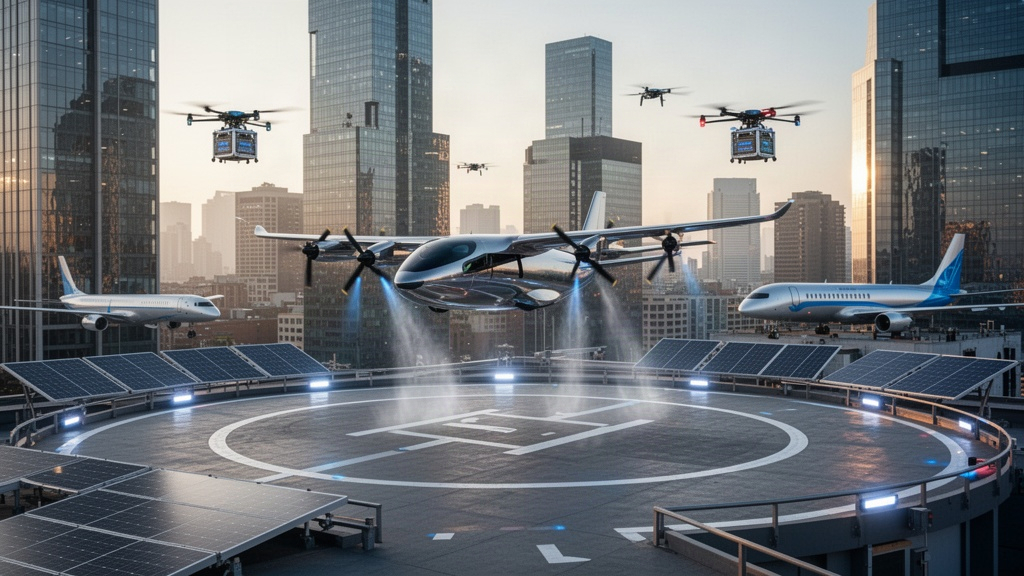
The transport sector is undergoing a profound shift, and aerospace companies are at the center of it. What was once confined to building aircraft and launching satellites has expanded into a much broader mission: redesigning how people and goods move across cities, continents, and even orbital paths. Players like Boeing, Airbus, SpaceX, and a wave of newer entrants are pushing boundaries that traditional transport industries never reached. The pressure comes from multiple directions at once — climate targets, urban congestion, demand for faster connectivity, and the maturation of electric and autonomous technologies. Understanding what these companies are actually building, and what obstacles remain, matters for anyone tracking the future of mobility.
Why aerospace companies are becoming transport innovators
Aerospace was never just about planes. The sector has always operated at the intersection of engineering, regulation, and geopolitics — which gives its leading firms a unique capacity to drive systemic change across transport networks. Today, that capacity is being directed toward problems that go well beyond altitude and airspeed.
Joby Aviation, Archer Aviation, and Wisk Aero are developing aircraft designed to replace short urban car journeys. SpaceX and Rocket Lab are building the satellite infrastructure that will underpin next-generation logistics tracking and air traffic management. GE Aerospace and Rolls-Royce are redesigning engines to cut fuel burn on routes that carry hundreds of millions of passengers annually. These are not peripheral projects — they reflect a deliberate repositioning of the aerospace industry as a transport infrastructure provider.
Part of this shift is driven by market necessity. Commercial aviation recovered strongly after the disruptions of the early 2020s, but airlines face mounting pressure from carbon pricing schemes, tighter emissions standards, and passengers who increasingly scrutinize environmental performance. Aerospace suppliers that can offer cleaner, smarter, or more cost-effective solutions gain a direct competitive edge. The International Civil Aviation Organization (ICAO) has set a net-zero carbon target for international aviation by 2050, giving the entire supply chain a hard deadline to work toward.
Digital tools are accelerating this transformation. Digital twin technology — virtual replicas of aircraft, engines, or airport systems fed by real-time data — allows manufacturers and operators to predict failures, reduce maintenance downtime, and cut unnecessary fuel consumption. Autonomous flight systems, still tightly regulated by bodies like the Federal Aviation Administration (FAA) and the European Union Aviation Safety Agency (EASA), are moving from research labs toward limited commercial deployment. The aerospace sector is not simply building faster machines. It is building smarter transport systems.
Read also: Top 10 aerospace companies shaping the future of flight
From SAF to electric propulsion: the race to decarbonize flight
Aviation accounted for approximately 2.5% of global energy-related CO2 emissions in 2018, according to the International Energy Agency. That figure understates the full climate impact when non-CO2 effects such as contrail formation are included. Closing that gap requires multiple parallel technology tracks, each with different timelines and constraints.
Sustainable Aviation Fuel (SAF) is the nearest-term solution for large commercial aircraft. Produced from non-fossil sources including certain waste streams and synthetic processes, SAF can be blended with conventional jet fuel and used in existing engines without modification. IATA projected that SAF would account for around 0.6% of airline fuel consumption in 2025 — a tiny share, but one that is growing as production capacity scales. The EU's ReFuelEU Aviation regulation mandates minimum SAF blending thresholds at European airports: 2% in 2025, rising to 6% by 2030 and 70% by 2050. SAF is not carbon-neutral by default; its lifecycle emissions depend heavily on feedstock, production method, and supply chain.
Electric propulsion offers a cleaner path for shorter routes and lighter aircraft. Battery energy density remains the binding constraint: current technology makes fully electric flight practical for aircraft carrying fewer than roughly 20 passengers over short distances. Hybrid-electric systems, which pair conventional turbines with electric motors, can deliver efficiency gains on regional routes without the range limitations of pure battery power. Hydrogen is a longer-horizon option — Airbus has publicly committed to hydrogen-powered commercial aircraft, though the infrastructure and certification challenges are substantial.
Engine efficiency improvements from companies like Safran and GE Aerospace continue to deliver incremental but meaningful reductions in fuel burn on existing fleets. For the bulk of commercial aviation, these improvements and SAF adoption will do most of the decarbonization work over the next two decades.
How aerospace companies are opening the skies to new mobility
Advanced air mobility is the segment attracting the most attention and the most skepticism simultaneously. The concept covers electric vertical takeoff and landing aircraft (eVTOLs), autonomous cargo drones, and regional air taxis designed to operate above congested urban road networks. The technology is real. The path to commercial scale is harder.
Read also: The significance of the stock price Apple computer in 2026
Certification is the primary bottleneck. The FAA's processes for novel aircraft categories are thorough, and rightly so — these vehicles will operate over populated areas. Joby Aviation and Archer Aviation have made measurable progress through the FAA certification process, but exact entry-into-service dates remain subject to ongoing testing and regulatory review. EASA is developing its own framework for urban air mobility operations in Europe.
Infrastructure presents a second challenge. Vertiports — the landing pads and charging stations that eVTOLs require — need to be integrated into existing urban planning frameworks. Noise remains a concern even for electric aircraft, particularly in dense residential areas. The economics of air taxi services also need to demonstrate viability beyond premium pricing for early adopters.
Embraer's Eve Air Mobility subsidiary and Wisk Aero, backed by Boeing, are pursuing autonomous urban air mobility from different angles. Wisk focuses on pilotless operations, which could reduce operating costs significantly but face the highest regulatory bar. Eve targets a piloted model initially, with autonomy introduced progressively. Neither approach has a guaranteed timeline to widespread deployment.
For cargo, the picture is somewhat clearer. Autonomous drone delivery for medical supplies and light freight is already operating in limited geographic areas, providing real-world data that will inform future regulatory frameworks for passenger operations.
Reusable rockets and satellites are reshaping global connectivity
SpaceX's development of reusable launch vehicles changed the economics of reaching orbit. By recovering and relaunching rocket components, the marginal cost of certain missions has fallen significantly, though total costs still depend on development investment, maintenance cadence, and infrastructure. Blue Origin and Rocket Lab are pursuing their own reusability strategies at different scales.
Read also: The rise of plant-based menus in the restaurant chain sector
The transport implications extend well beyond the launch pad. Satellite constellations in low Earth orbit now provide broadband connectivity to aircraft, ships, and remote logistics operations that previously had no reliable data link. This connectivity enables real-time route optimization, predictive maintenance alerts sent from aircraft in flight, and supply chain visibility across global networks. The Federal Communications Commission (FCC) manages spectrum licensing for these systems in the United States, while ICAO coordinates their integration into aviation communications standards.
NASA's X-59 demonstrator, developed under the Quesst program, is testing whether supersonic overland flight can produce a low-level thump rather than a disruptive sonic boom. If the data supports regulatory change, commercial supersonic transport over land could become viable — a prospect that companies like Boom Supersonic are already designing aircraft around.
What will determine the commercial success of these technologies?
| Technology | Target Use | Maturity (2026) | Main Advantage | Major Obstacle | Deployment Horizon |
|---|---|---|---|---|---|
| SAF | Commercial aviation | Commercially available, low volume | Drop-in compatibility with existing fleets | Production cost and feedstock supply | Scaling through 2030s |
| Electric propulsion | Short-haul, light aircraft | Limited commercial deployment | Near-zero operational emissions | Battery energy density | Gradual, route-dependent |
| Hydrogen propulsion | Regional and medium-haul | Research and prototype stage | High energy density, clean combustion | Infrastructure and certification | Post-2035 |
| eVTOL / Urban air mobility | Urban passenger transport | Pre-certification / early certification | Bypasses road congestion | Vertiport infrastructure, noise, cost | Limited launch markets near-term |
| Reusable launch vehicles | Satellite deployment, cargo | Operational (SpaceX, Rocket Lab) | Reduced marginal launch cost | Turnaround rate, regulatory licensing | Expanding now |
Safety certification, not innovation speed, will ultimately set the pace. The FAA, EASA, and ICAO do not approve technologies on commercial timelines — they approve them when the evidence of safety is sufficient. Companies that treat certification as an afterthought routinely face delays that erase first-mover advantages.
Cost structures matter as much as technical performance. A hydrogen-powered regional aircraft that requires airport infrastructure investments of hundreds of millions of dollars per location will struggle to find airline customers, regardless of its emissions profile. Social acceptance is a factor that engineers sometimes underestimate: communities near vertiport sites or supersonic flight corridors have legitimate concerns about noise and safety that require genuine engagement, not just regulatory compliance.
The aerospace companies most likely to shape transport over the next two decades are those that combine engineering credibility with regulatory literacy and a clear understanding of operator economics. The technology itself is rarely the limiting factor. The ability to deliver certified, affordable, and operationally practical systems at scale — that is where the real competition is being decided.