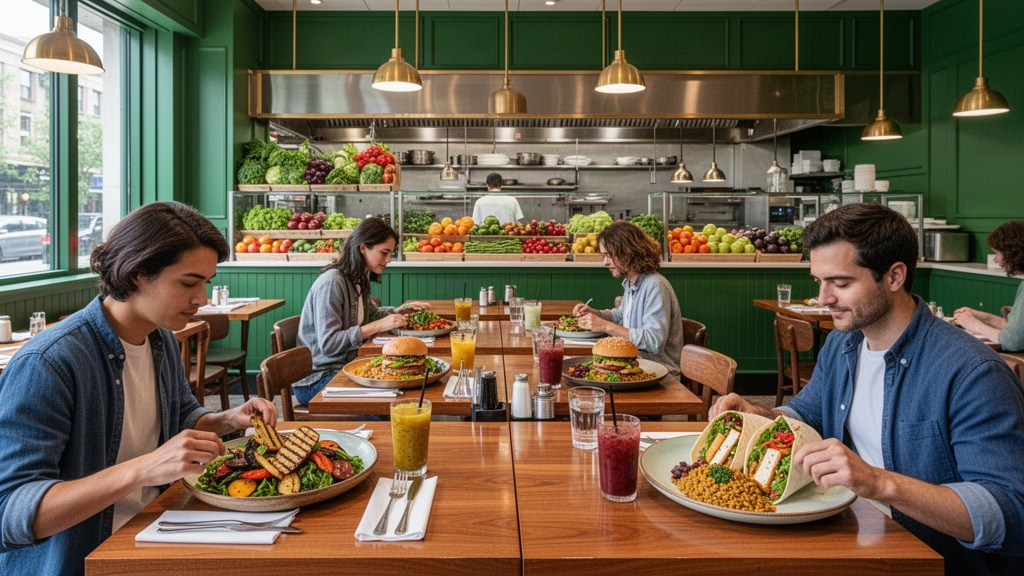
The plant-based menu has moved from niche curiosity to boardroom priority across the food service industry. Every major restaurant chain operating at scale — from fast food giants to casual dining brands — has had to take a position on it. Some launched dedicated product lines, others quietly added a veggie burger and moved on. The commercial logic is real: flexitarian consumers now represent a significant share of the dining-out population, and groups looking for a table increasingly include at least one person avoiding meat. Plant-based offerings have become a filter for inclusion. Getting the strategy right, though, requires more than swapping beef for a pea protein patty. It demands honest thinking about pricing, kitchen operations, supplier relationships, and what customers actually want when they order something that does not contain meat.
Why plant-based menus are gaining ground across the restaurant chain market
Demand did not appear overnight. The shift toward flexitarian eating — reducing meat consumption without eliminating it entirely — has been building for over a decade, driven by a combination of health awareness, environmental concern, and simple curiosity about new flavours. Chains with thousands of locations cannot ignore a dietary preference held by a growing portion of their customer base.
The Good Food Institute and the Plant Based Foods Association have tracked the US retail plant-based food market reaching around $8.1 billion in sales, though this figure covers retail broadly and should not be read as a direct measure of restaurant performance. What it does signal is that consumer familiarity with plant-based products has grown substantially. People who buy oat milk at the supermarket expect to find it on a coffee chain menu. That expectation has migrated across every food service format.
Product innovation also changed what chains could realistically offer. Meat analogues — products designed to replicate the taste, texture, and appearance of meat using predominantly plant ingredients — reached a level of quality that made them viable for mainstream menus. Suppliers like Beyond Meat, Impossible Foods, and Quorn built commercial partnerships with major operators, giving chains access to scalable supply. Separately, operators rediscovered naturally plant-based dishes: grain bowls, legume-based wraps, vegetable-forward sides that required no reformulation and carried lower ingredient costs.
Environmental framing added another layer. Younger consumers in particular associate reduced meat consumption with lower carbon footprints, and chains have used plant-based launches to signal broader sustainability commitments. Whether those claims hold up under scrutiny depends on the specific product and supply chain — a processed meat analogue is not automatically more sustainable than a conventional protein — but the marketing momentum has been consistent.
Read also: What are the bonds you need to start investing wisely
How major operators are adapting their menus
The strategies vary widely. Some chains pursued permanent menu integration, treating a plant-based burger or wrap as a standard item sitting alongside its meat equivalent. Others used limited-time offers to test demand without committing to supply chain investment or staff retraining. Both approaches carry different risk profiles.
Permanent listings require reliable supplier agreements, consistent portion specs, and staff trained to handle preparation separately to avoid cross-contamination — the unintended transfer of allergens or animal ingredients during cooking, storage, or service. For a chain operating hundreds of franchised locations, standardising that process is genuinely complex. A franchisee running a tight kitchen with limited equipment cannot always guarantee the same separation protocols as a company-owned flagship.
Limited-time offers reduce that operational burden but create a different problem: consumer trust. Customers who build a habit around a plant-based item and then find it removed from the menu tend not to return for it when it reappears. Menu penetration — the proportion of locations or menu references carrying a plant-based option — matters as much as the launch announcement.
Several chains have also moved toward naturally plant-based dishes rather than meat analogues. A lentil dahl, a falafel wrap, or a mushroom-based main does not carry the same premium ingredient cost as a reformulated protein product, and it appeals to a broader audience including customers who are sceptical of heavily processed alternatives. This approach also sidesteps the definitional complexity around vegan versus plant-based: a naturally vegetable-based dish is easier to describe accurately than a product that contains plant proteins but may be cooked on shared equipment with meat.
Consumer demand versus operational reality
There is a gap between what customers say they want and what they order. Surveys consistently show strong stated interest in plant-based options, but menu sales data from operators has been more mixed. Between 2022 and 2024, several categories saw volume pressure as food inflation pushed consumers toward familiar, lower-cost choices. A plant-based burger priced above its beef equivalent faces a harder sell when household budgets are stretched.
Read also: 10 reasons urban farming can enhance your business model
Pricing is not the only friction point. Taste and texture expectations remain a genuine barrier for meat-reducers who are not committed vegans or vegetarians. A customer who orders a plant-based patty and finds it dry or oddly seasoned will not reorder. The National Restaurant Association has noted that flavour quality is the primary driver of repeat purchase for any menu item, plant-based or otherwise. Chains that launched products too quickly — before formulations were refined — paid a reputational cost that affected subsequent launches.
Regulatory requirements add further complexity. In the United States, the FDA sets rules on ingredient labelling and allergen disclosure. The FTC governs advertising claims, including environmental ones. In the UK, the Food Standards Agency sets equivalent standards for allergen information and marketing accuracy. A chain operating across multiple markets must navigate different labelling obligations, different definitions of terms like "vegan," and different consumer protection standards — all while maintaining consistent brand messaging.
The business case for a broader plant-based offer
The commercial argument is straightforward when it works. A table of six that includes one vegan and one vegetarian will choose a restaurant that accommodates both over one that does not. Group dining decisions are often made by the person with the most dietary restrictions, which means a single plant-based option can determine where an entire group spends money. Chains that understand this dynamic treat plant-based menus as a table acquisition tool, not just a product category.
The comparison below sets out four distinct approaches to plant-based menu design, with their respective commercial advantages and operational constraints.
Read also: How VIX Stock Can Help You Navigate Market Fluctuations
| Proposition | Target customer | Commercial advantages | Operational constraints | Perception risks | Performance indicators |
|---|---|---|---|---|---|
| Dedicated vegan option | Committed vegans, allergen-conscious diners | Clear brand signal, loyal niche audience | Strict cross-contamination protocols, staff training | Scepticism if preparation standards are inconsistent | Repeat purchase rate, vegan customer acquisition |
| Meat analogue (e.g. plant-based burger) | Flexitarians, curious omnivores | High visibility, PR value, familiar format | Ingredient cost, supplier dependency, formulation quality | Perceived as overly processed or overpriced | Units sold per location, price sensitivity data |
| Naturally plant-based dish | Broad audience including non-vegetarians | Lower ingredient cost, easier labelling, wider appeal | Recipe development, staff familiarity with preparation | May not satisfy customers seeking a meat substitute | Sales mix, margin per dish, customer satisfaction scores |
| Seasonal plant-based offer | Trend-driven consumers, occasional plant-based eaters | Generates media coverage, tests demand with low commitment | Supply chain for short runs, menu retraining each cycle | Customers frustrated by item removal; inconsistent availability | Sell-through rate, social media engagement, trial-to-repeat ratio |
Menu engineering — the structured analysis of dish profitability, popularity, and positioning — determines which of these approaches suits a given chain's margin structure. A high-volume fast food operator will calculate differently from a mid-market casual dining brand with lower table turnover and higher average spend per cover.
What the next phase of plant-based dining actually looks like
The initial wave of plant-based launches was driven by novelty. That phase is over. What follows is a period of rationalisation: chains removing underperforming items, renegotiating supplier contracts, and focusing on the two or three plant-based dishes that actually sell consistently rather than maintaining a long list of options that few customers order.
Ingredient costs are shifting. As alternative protein suppliers scale production and competition between them increases, the price premium for meat analogues is narrowing. That changes the margin calculation for operators who previously found plant-based items difficult to price competitively. Lower input costs make permanent menu placement more viable without requiring a price premium that alienates budget-conscious customers.
Transparency is becoming a differentiator. Chains that can accurately describe what is in a dish — its ingredients, its preparation method, whether it qualifies as vegan or simply plant-forward — build more durable trust than those relying on vague marketing language. The distinction between plant-based and vegan matters to a significant subset of customers, and getting it wrong carries reputational and regulatory risk. Both the FDA in the US and the Food Standards Agency in the UK have frameworks that require accuracy in food labelling and advertising claims.
The chains that will perform best over the next several years are not necessarily those with the longest plant-based menus. They are the ones that treat plant-based dishes with the same rigour applied to any other menu item: tested for taste, priced for margin, prepared consistently across locations, and communicated honestly to customers who have become considerably more knowledgeable about what they are eating.