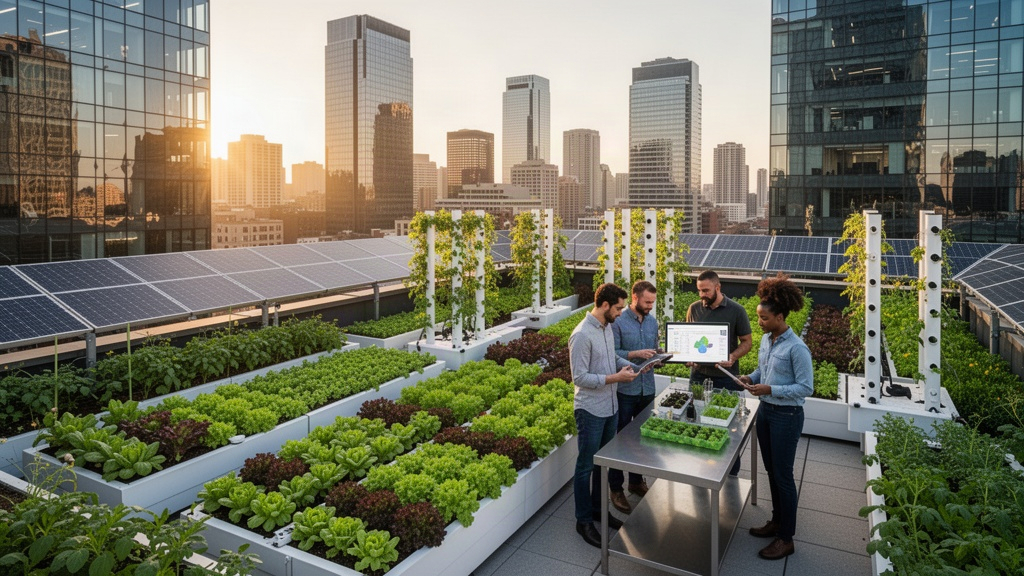
Urban farming has moved well beyond community gardens and weekend hobby plots. Businesses across the United States and United Kingdom are now integrating food production directly into their operations, their buildings, and their brand identities. According to UN-Habitat, nearly 70% of the world's population is projected to live in urban areas by 2050, creating both pressure on food supply chains and a genuine commercial opening for companies willing to act early. Whether you run a restaurant group, a property company, a corporate campus, or a retail brand, urban agriculture offers a surprisingly versatile set of levers to differentiate your offer, generate new income, and build resilience into your business model.
Why urban farming is becoming a strategic business opportunity
The timing matters. Supply chain disruptions over recent years pushed businesses to rethink where their ingredients and fresh goods come from. Long-distance sourcing, while often cheaper on paper, carries hidden risks: weather events, logistics failures, and price volatility tied to fuel costs. Urban food production shortens those chains considerably, giving businesses more direct control over quality and availability.
Demand is also shifting. Consumers in major cities are paying close attention to food provenance, and many are willing to pay a premium for produce grown locally. Retailers, restaurant groups, and corporate catering operations that can demonstrate proximity between field and fork gain a meaningful edge in competitive markets. The USDA's Urban Agriculture and Innovative Production program has recognised this shift, channelling funding and technical support toward urban food businesses precisely because the sector addresses both market demand and food security goals.
Beyond food, urban farming creates value through real estate. Underused rooftops, vacant lots, and basement spaces represent assets that most businesses simply ignore. Converting those spaces into productive growing areas generates returns from square footage that would otherwise sit idle. The EPA's green infrastructure guidance also highlights that rooftop vegetation reduces stormwater runoff and lowers building temperatures, adding environmental performance to the financial case.
Regulatory environments are adapting. Cities including New York, Chicago, and London have updated zoning rules to accommodate commercial growing operations, and some offer tax incentives or grants for qualifying projects. That said, local regulations vary enormously: food safety requirements under the FDA in the US and the UK Food Standards Agency follow different frameworks, and building permits for rooftop loads or water systems must be verified jurisdiction by jurisdiction before any investment is made.
Read also: The rise of plant-based menus in the restaurant chain sector
Ten ways it can strengthen your business model
The practical case for urban agriculture in a business context breaks down into concrete revenue and efficiency levers. These are not theoretical benefits — each one has been demonstrated by operating businesses in cities across North America and the UK.
- Diversified revenue streams: sell fresh produce directly, through subscriptions, or via contracts with restaurants and food service operators, reducing dependence on a single income source.
- Brand differentiation: a rooftop farm or vertical growing wall gives your brand a visible, tangible story that marketing copy alone cannot replicate.
- B2B contract opportunities: hotels, hospitals, schools, and corporate canteens actively seek local suppliers who can guarantee consistent, traceable supply.
- Reduced food miles on your own supply: businesses that grow even a portion of what they serve or sell cut transport costs and gain greater freshness control.
- Monetising underused assets: rooftops, courtyards, and vacant floors become productive, income-generating spaces rather than maintenance liabilities.
- Workshop and experience revenue: growing tours, cooking classes tied to the harvest, and corporate team-building sessions create high-margin add-on income.
- Staff engagement and wellbeing: companies with on-site growing spaces report stronger employee connection to the workplace, which matters for retention in competitive hiring markets.
- Sustainability credentials: measurable environmental performance data from your growing operation supports ESG reporting and procurement requirements from larger clients.
- Partnership and co-branding potential: technology suppliers, seed companies, nutrition brands, and local authorities all seek credible urban farming partners for joint projects and funding bids.
- Resilience against price volatility: growing a portion of your inputs in-house provides a partial buffer when wholesale prices spike, particularly for high-value herbs, microgreens, and salad leaves.
The combination of these levers is what makes urban farming commercially interesting. No single benefit justifies the investment on its own, but several operating together create a genuinely differentiated and more resilient business model.
Choosing the right production and revenue strategy
Not every urban farming format suits every business. The choice between rooftop farming, vertical farming, hydroponics, aquaponics, and in-ground urban plots depends on your available space, energy costs, capital budget, and target market.
Rooftop farming works well for property owners and hospitality businesses with accessible, structurally sound roof space. The main constraints are load-bearing capacity, waterproofing, wind exposure, and water access. Returns can be solid when the produce feeds a restaurant below or is sold through a weekly box scheme, but the setup costs for structural assessment, drainage, and irrigation are real and must be factored in from day one.
Read also: How to analyze Microsoft stock like a financial expert
Vertical farming and controlled environment agriculture (CEA) offer year-round production and very high yields per square metre, which is attractive for businesses needing consistent volume. The trade-off is energy consumption. Artificial lighting and climate control can generate significant electricity bills, and the environmental benefit of growing locally can be partially offset if the electricity supply is carbon-intensive. Businesses considering this route should model energy costs carefully and explore renewable tariffs where available.
Hydroponics suits businesses that want soil-free growing with efficient water use. Compared to conventional field agriculture, hydroponic systems can use substantially less water for equivalent yields, though the exact savings depend on the crop, the system design, and what baseline you are comparing against. Aquaponics adds a fish-rearing component that produces both protein and the nutrients that feed the plants, creating a closed-loop system that appeals strongly to sustainability-focused brands.
Revenue strategy should be mapped before choosing the production format. A business targeting restaurant contracts needs consistent volume and reliable harvest scheduling. A brand building consumer loyalty through experience might prioritise a visible rooftop garden over a hidden basement vertical farm. Matching the format to the commercial objective avoids the common mistake of investing in impressive technology that serves no clear customer need.
How to assess commercial viability before investing
The single biggest error businesses make with urban farming is treating it as a marketing project rather than an operational one. Commercial viability requires the same rigour as any other capital investment: demand validation, cost modelling, and a realistic path to positive cash flow.
Read also: Step-by-Step Approach: How to Start Investing Stocks for Profit
Start with the demand side. Who will buy the produce, at what price, and in what volumes? Talk to potential customers before spending anything on infrastructure. Restaurants and food service operators will tell you quickly whether your proposed crop mix and delivery schedule fits their needs. Subscription box models require a committed customer base that takes time to build. B2B contracts offer more predictable revenue but often require food safety certification and traceability documentation from day one.
On the cost side, the variables that most often catch businesses off guard are energy, labour, and compliance. Energy costs for indoor growing can be substantial. Labour for daily growing operations is skilled and ongoing. Compliance with FDA food safety rules in the US, or FSA requirements in the UK, involves documentation, testing, and potentially facility modifications that add to the upfront investment.
A realistic financial model should cover at minimum: space cost or rental value, fit-out and equipment, energy at current and projected rates, labour hours, consumables, and the time to reach target production volume. Build in a margin of error. Many urban farms take 18 to 24 months to reach stable operating performance, so the business must be able to absorb that ramp-up period without the growing operation becoming a drain on core activities.
The USDA's National Agricultural Statistics Service and equivalent UK bodies publish data on wholesale produce prices that can anchor your revenue projections to market reality. Use those figures, not optimistic assumptions, to stress-test your model. Urban farming rewards businesses that approach it with operational discipline and a clear commercial purpose — and it punishes those that treat it as a trend to follow without a plan behind it.