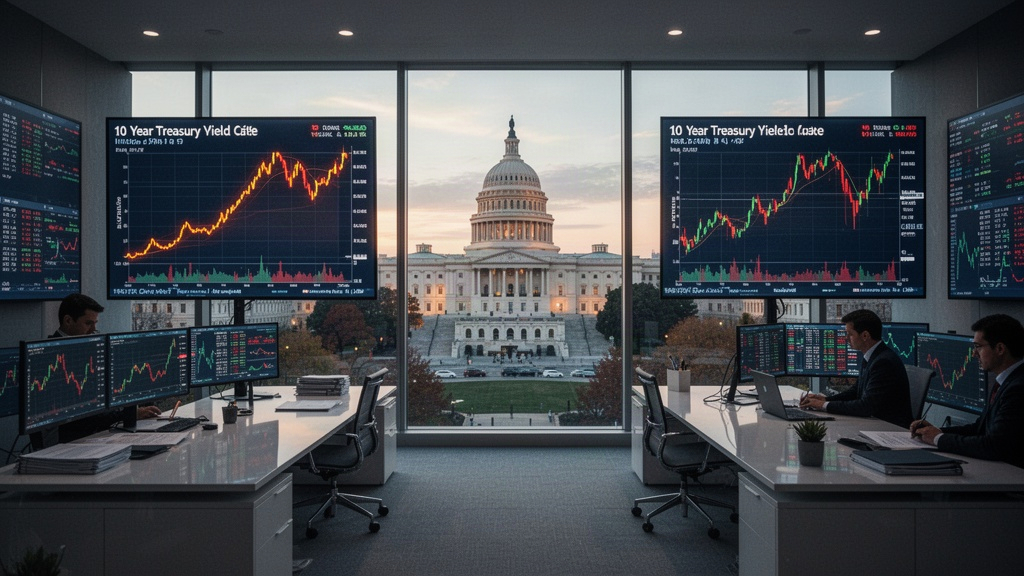
Few market indicators carry as much weight as the 10 years treasury yield. It shapes mortgage rates, corporate borrowing costs, equity valuations and government financing decisions simultaneously. When this single number moves by half a percentage point, billions of dollars shift across asset classes within hours. Understanding where it stands and where it may be heading is not an academic exercise — it is a practical requirement for any business leader, CFO or investor managing capital in today's environment. The yield on the 10-year Treasury note reflects the collective judgment of the market about inflation, growth and risk over the next decade. That judgment changes constantly, and the institutions watching it most closely include the Federal Reserve, pension funds, insurance companies and primary dealers who operate at the center of U.S. debt markets.
What Is the 10 Years Treasury Yield and Why Does It Matter?
The U.S. Department of the Treasury issues debt across a range of maturities. Treasury notes, which cover maturities from two to ten years, represent the most actively traded segment of the government bond market. The 10-year note sits at the long end of that range, and its yield — expressed as an annualized percentage — is determined not by any government decree but by continuous buying and selling on the secondary market.
Bond pricing works inversely to yield. When demand for the 10-year note rises, its price increases and the yield falls. When investors sell, prices drop and yields climb. This relationship means the yield constantly incorporates new information: an unexpected inflation print, a shift in Federal Open Market Committee language, or a surge in foreign demand for safe assets can all move the rate within a single trading session.
The distinction between the 10-year yield and the federal funds rate matters enormously. The FOMC sets the overnight lending rate between banks; the 10-year yield is set by the market. The two are related but not identical. During periods of aggressive rate hikes, the 10-year yield may rise less than short-term rates — or even fall — if investors believe the tightening cycle will eventually slow growth and inflation.
Why does this number matter so broadly? Mortgage lenders price 30-year home loans with reference to the 10-year Treasury. Corporate treasurers benchmark their bond issuance against it. Equity analysts use it as the risk-free rate in discounted cash flow models. A rise in the 10-year yield increases the cost of capital across the entire economy, compressing valuations and raising the hurdle rate for new investment. A sustained decline does the opposite, making long-duration assets more attractive and encouraging borrowing. No other single data point has such a wide reach across financial markets.
Read also: Understand 10 Years Treasury Yield to Enhance Your Investments
The Federal Reserve Bank of St. Louis publishes the historical series under the ticker DGS10 on its FRED database, offering decades of daily data. The U.S. Treasury itself publishes the constant maturity rate — a theoretical yield calculated to represent a bond with exactly ten years remaining, regardless of which specific notes are trading on a given day. Both sources are widely used by analysts, and both are freely accessible.
The Main Forces Shaping Long-Term Treasury Rates
No single variable drives the 10-year yield. The rate reflects a combination of factors that interact in ways that are sometimes predictable and sometimes not. Identifying those forces is the starting point for any serious forecast.
The most direct influence is inflation expectations. Investors demand a higher nominal yield when they expect purchasing power to erode over the life of the bond. The breakeven inflation rate — the spread between a standard 10-year Treasury and a 10-year Treasury Inflation-Protected Security (TIPS) — provides a real-time read on where the market sees inflation settling. When that breakeven rises, nominal yields tend to follow.
The following factors each exert measurable pressure on where the 10-year yield settles:
- FOMC policy signals: Forward guidance from the Federal Reserve shapes expectations about the future path of short-term rates, which feeds into long-term yields through rate expectations and the term premium.
- Federal fiscal deficits: Larger deficits require the Treasury to issue more debt. Higher supply, without a proportional increase in demand, pushes yields up.
- Real economic growth: Strong GDP growth tends to raise yields as investors rotate toward riskier assets and anticipate tighter monetary policy.
- International demand: Foreign central banks and sovereign wealth funds hold large quantities of U.S. Treasuries. Shifts in their buying behavior — driven by currency management, geopolitical considerations or domestic fiscal needs — directly affect yield levels.
- Term premium: This is the extra return investors require for locking up capital for ten years rather than rolling over short-term instruments. The term premium is not directly observable but can be estimated; it has fluctuated between negative territory and elevated positive readings over the past decade.
- Inflation data releases: Monthly CPI and PCE reports can trigger sharp yield moves when they deviate from consensus expectations, sometimes by ten or more basis points in a single day.
The interplay between these forces means that even a well-reasoned forecast can be overturned quickly. A geopolitical shock that drives safe-haven demand into Treasuries can push yields down even as domestic inflation data points higher. That tension is inherent to long-term rate forecasting.
Read also: What is financial education and why it should not be ignored
Three Scenarios for the Years Ahead
Rather than committing to a single forecast — which no institution can make with confidence — it is more useful to map out the conditions under which yields rise, stabilize or fall. Each scenario has distinct implications for business planning.
In a declining yield scenario, inflation returns sustainably toward the Federal Reserve's 2% target, the FOMC cuts rates across multiple meetings, and growth moderates without tipping into a sharp contraction. Demand for safe assets remains strong. Under these conditions, the 10-year yield could drift meaningfully lower from current levels. Businesses with floating-rate debt would benefit from refinancing opportunities, and long-duration bond portfolios would appreciate. The risk with this scenario is that a rapid rate decline may signal weaker growth, which creates its own set of earnings pressures.
A range-bound scenario assumes that inflation stays above target but not dramatically so, that the Fed holds rates steady for an extended period, and that Treasury issuance remains heavy due to persistent fiscal deficits. In this environment, the 10-year yield oscillates within a band but does not break decisively in either direction. This is arguably the most operationally demanding scenario for corporate finance teams, because planning becomes difficult without a clear directional signal. Cost of capital remains elevated, and refinancing decisions carry real uncertainty.
The rising yield scenario materializes if inflation re-accelerates, if the Congressional Budget Office projections on federal debt prove too optimistic, or if foreign buyers reduce their Treasury holdings. A sustained rise in the term premium — driven by uncertainty about U.S. fiscal policy — could push long-term yields to levels not seen in over a decade. This scenario would compress equity multiples, increase mortgage rates further and raise the cost of new corporate bond issuance significantly.
None of these paths is inevitable. The honest assessment is that the range of plausible outcomes for the 10-year yield over the next two to three years remains wide, and any precise point forecast should be treated with appropriate skepticism.
Read also: Step-by-Step Approach: How to Start Investing Stocks for Profit
How Businesses Can Monitor and Prepare for Rate Changes
Watching the 10-year yield should be a routine part of any corporate treasury function, not a reaction to a crisis. The U.S. Treasury's Daily Par Yield Curve Rates page and the FRED database both provide free, reliable data updated each business day. Building a simple dashboard that tracks the 10-year yield alongside the 2-year yield gives an immediate read on the shape of the yield curve.
The spread between the 2-year and 10-year Treasury yields carries real information. When short-term yields exceed long-term ones — an inverted yield curve — markets are pricing in expectations of future rate cuts, often because growth is expected to slow. An inverted yield curve preceded every U.S. recession in the post-war period, though the timing between inversion and contraction varies considerably. Businesses that track this spread can make more informed decisions about inventory, capital expenditure and debt maturity profiles.
Scenario analysis on the cost of capital should become a standard part of annual planning. Running three versions of a financial model — one with yields 75 basis points lower, one flat, one 75 basis points higher — forces management teams to confront the sensitivity of their business to rate changes. Companies with significant floating-rate debt or upcoming refinancing needs face the most direct exposure and should assess whether interest rate hedging instruments are appropriate for their situation.
Beyond internal modeling, reading FOMC statements and the quarterly Summary of Economic Projections gives advance notice of how policymakers themselves are thinking about the rate path. Primary dealers who participate in Treasury auctions also publish research that reflects real positioning in the market, not just theoretical models. Combining official data, auction results and dealer commentary gives a more complete picture than any single source alone.
The 10-year Treasury yield will keep moving. The businesses that manage it well are those that build rate sensitivity into their planning before the market forces the question.