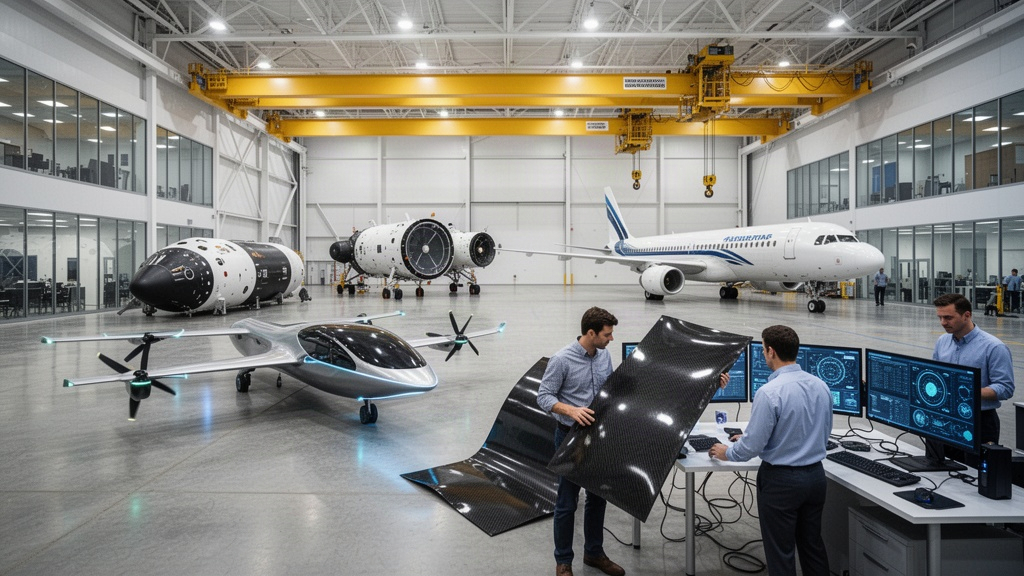
The global aerospace companies sector generated approximately $960 billion in revenues in 2023, according to Deloitte estimates — a figure that spans commercial aviation, military systems, and orbital launches. That scale reflects an industry undergoing genuine structural change. Reusable launch vehicles have cut the cost of reaching orbit. Sustainable aviation fuels are moving from test programs into airline contracts. Autonomous systems are advancing faster than certification frameworks can track. Ten companies sit at the center of these shifts, not because they are the largest by revenue alone, but because their technology choices, government contracts, and strategic bets will define what flight looks like through 2030 and beyond. Understanding who they are — and what differentiates them — matters for investors, engineers, policy analysts, and anyone watching the future of transportation take shape.
How these aerospace companies were selected
No single ranking of aerospace companies commands universal agreement, and that is worth stating plainly. Revenue is one measure, but a company generating $30 billion in propulsion systems shapes aviation differently than one generating $70 billion across defense electronics. The ten names here were chosen against four criteria: annual revenue scale, demonstrated technological differentiation, strategic influence over commercial or government programs, and credible positioning in the next generation of flight technology.
Defense-only contractors qualify when their aerospace work — stealth aircraft, space systems, autonomous platforms — directly advances aviation capability. New space entrants qualify when they have operational launch records, not just announced ambitions. Propulsion and systems suppliers qualify when their technology appears across multiple OEM platforms, making them structural to the industry rather than peripheral to it.
The result is a list that mixes Original Equipment Manufacturers, propulsion specialists, defense primes, and commercial space operators. Revenue figures cited come from 2023 annual reports unless otherwise noted; more recent filings should be consulted before drawing investment conclusions.
Ten companies redefining aviation and space
Airbus recorded €65.4 billion in revenue in 2023 and remains the world's largest commercial aircraft manufacturer by deliveries. Its A320neo family dominates narrow-body orders, while the A350 holds firm in long-haul markets. Airbus is also the lead contractor on several European Space Agency programs and is developing hydrogen propulsion concepts targeting service entry around 2035.
Boeing posted $77.8 billion in 2023 revenue, though that figure came alongside well-documented production and safety challenges on the 737 MAX program. The 787 Dreamliner and 777X remain strategically significant, and Boeing's defense division — covering the F-15EX and space systems — provides substantial revenue diversification.
Read also: How to Start Investing: Essential Tips for 2026
Lockheed Martin brought in $67.6 billion in 2023. The F-35 Lightning II program alone accounts for roughly a quarter of annual revenue, and Lockheed's space division manages Orion capsule production for NASA's Artemis lunar program. Its work on hypersonic systems and directed energy weapons positions it firmly in next-generation defense.
RTX — the parent of Collins Aerospace, Pratt & Whitney, and Raytheon — generated $68.9 billion in 2023. Pratt & Whitney's GTF engine powers the A320neo family, making RTX an unavoidable supplier for Airbus's best-selling platform. Collins provides avionics and cabin systems across virtually every commercial aircraft type in production.
Northrop Grumman reached $39.3 billion in 2023 revenue. Its B-21 Raider stealth bomber program is the most significant new manned military aircraft in decades, and its Space Systems division builds satellite buses and missile defense components for the U.S. Space Force.
GE Aerospace reported approximately $31.6 billion in 2023 and has operated as a standalone company since separating from GE Vernova in April 2024. Its LEAP engine, co-developed with Safran through CFM International, powers both the Boeing 737 MAX and Airbus A320neo — a market position with few parallels in industrial history.
SpaceX does not publish audited financials, but independent estimates place annual revenue above $9 billion, with the Starlink satellite constellation generating recurring subscription income. Its Falcon 9 rocket has the highest orbital launch cadence of any vehicle in history, and Starship development continues with progressively more capable test flights.
Blue Origin returned to orbital ambitions with the New Glenn rocket, which completed its first orbital mission in early 2025. Backed by Jeff Bezos, the company holds NASA contracts for lunar landing systems and is developing the BE-4 engine, which also powers United Launch Alliance's Vulcan Centaur rocket.
Read also: How aerospace companies are changing the future of transport
Safran is a French company with genuinely global reach. Through the CFM International joint venture with GE Aerospace, it co-produces the world's best-selling commercial aircraft engine family. Its landing systems and nacelles appear on Airbus, Boeing, and regional aircraft platforms worldwide.
BAE Systems rounds out the list as the UK's largest defense contractor and a partner on the Global Combat Air Programme alongside Japan and Italy. Its electronic systems division supplies avionics, electronic warfare, and cyber capabilities to military aircraft programs across NATO member states.
The technologies changing how aircraft and rockets are built
Reusable launch vehicles have shifted the economics of orbital access more decisively than any policy change. SpaceX's Falcon 9 booster recovery program, now routine, demonstrated that reusability at scale is operationally viable — not just theoretically appealing. Blue Origin and others are following the same logic with New Glenn.
In commercial aviation, sustainable aviation fuels (SAF) have moved from pilot programs to supply agreements. Airlines are contracting SAF volumes years in advance, and engine manufacturers including GE Aerospace and Safran have confirmed full SAF compatibility for current-generation powerplants. The harder problem is production volume: SAF still represents a small fraction of total jet fuel consumption globally.
eVTOL aircraft — electric vertical take-off and landing vehicles — have attracted billions in private investment, though FAA certification timelines have proved longer than early projections. Joby Aviation, Archer, and Lilium (prior to its restructuring) represent a category that the established primes are watching rather than leading. Airbus has its own CityAirbus NextGen program, but urban air mobility remains a market that has not yet delivered commercial operations at scale.
Read also: What are the bonds you need to start investing wisely
Advanced manufacturing — specifically additive manufacturing and automated fiber placement for composite structures — is reducing both weight and production cycle times. GE Aerospace has used 3D-printed fuel nozzles in the LEAP engine since its entry into service, consolidating what was previously a 20-part assembly into a single printed component.
Comparing the ten: a structured view
| Company | Headquarters | Primary Segment | Signature Program | 2023 Revenue | Key Uncertainty |
|---|---|---|---|---|---|
| Airbus | Toulouse, France | Commercial aviation | A320neo family | €65.4 bn | Supply chain ramp-up |
| Boeing | Arlington, USA | Commercial & defense | 737 MAX / 787 | $77.8 bn | Production quality, certification |
| Lockheed Martin | Bethesda, USA | Defense & space | F-35 / Orion | $67.6 bn | F-35 sustainment costs |
| RTX | Arlington, USA | Propulsion & systems | GTF engine / Raytheon | $68.9 bn | GTF powder metal recalls |
| Northrop Grumman | Falls Church, USA | Defense & space | B-21 Raider | $39.3 bn | B-21 cost overruns |
| GE Aerospace | Cincinnati, USA | Propulsion | LEAP / GE9X | ~$31.6 bn | Post-separation integration |
| SpaceX | Hawthorne, USA | Launch & satellites | Falcon 9 / Starlink | Est. $9+ bn | Private; unaudited figures |
| Blue Origin | Kent, USA | Launch & lunar | New Glenn / BE-4 | Not disclosed | Cadence, cost competitiveness |
| Safran | Paris, France | Propulsion & equipment | LEAP (via CFM) | ~€23 bn | SAF transition timelines |
| BAE Systems | London, UK | Defense electronics | GCAP / Typhoon | ~£25 bn | GCAP schedule, export controls |
What to watch through 2030
The competitive hierarchy among these ten is not fixed. Boeing's recovery trajectory — or the pace of Airbus's supply chain expansion — will determine narrow-body market share for the next decade. Neither outcome is certain. Airbus has struggled to hit its own A320 family delivery targets, while Boeing is working through a regulatory relationship with the FAA that requires demonstrable quality system improvements before production rate increases are approved.
In space, the question is whether Starship achieves the launch cadence SpaceX has projected. A fully reusable heavy-lift vehicle at low marginal cost would reshape satellite deployment, lunar logistics, and potentially point-to-point transport economics. Blue Origin's New Glenn needs to demonstrate reliability across multiple missions before it can meaningfully compete for the commercial launch contracts that currently flow almost entirely to Falcon 9.
Defense budgets across NATO member states have increased since 2022, and that spending flows directly to Lockheed Martin, Northrop Grumman, BAE Systems, and RTX. The Global Combat Air Programme — linking BAE Systems with Japanese and Italian partners — is the most ambitious multinational fighter development since Eurofighter, with a target service entry in the mid-2030s.
Decarbonization will separate companies that treat sustainability as a compliance exercise from those building it into propulsion architecture. Hydrogen combustion and hybrid-electric regional aircraft are not commercial products yet, but the engineering decisions being made now by Airbus, GE Aerospace, and Safran will determine whether they become viable before 2035. The companies that solve propulsion efficiency at scale will hold a structural advantage that no amount of airframe optimization can replicate.
Certification risk cuts across all categories. The FAA, the UK Civil Aviation Authority, and EASA are all working through frameworks for autonomous aircraft, urban air mobility, and novel propulsion. Delays in those frameworks do not stop development, but they do delay revenue — and for smaller new entrants, that gap between readiness and certification can be fatal to a business model.